A striking image is an entrance
A cricket clip can be an excellent beginning. It catches a movement, a reaction or a turning moment that makes you want to know more. The problem begins when the selected image is asked to stand for everything outside its frame. A single shot might illustrate a batter's action while saying little about the innings around it. A celebration records a response, not an independent measurement of the event's importance. Begin with curiosity about the clip rather than a complete theory of the match.
This essay follows the steps between seeing a moment and making a claim about it. The examples are original and fictional. They do not refer to a named player, a particular competition or a concealed set of match results. The historical address is retained from an earlier website edition, but the current content is a new English cricket field note. It does not claim to preserve the old report or the language in which that report appeared.
Name the claim in plain words
Before looking for more evidence, state the proposition you want to examine. Perhaps a headline suggests that a batter changed approach, that a side lost control or that one decision transformed a chase. Those claims are not equivalent. A changed approach concerns a pattern of decisions. Lost control is an interpretation requiring a definition. A transformed chase concerns the match state and the sequence around the decision. Each needs a different kind of supporting material.
A useful first edit removes a vague superlative. Replace a claim that an innings was the greatest with a question about what made the innings unusual in a defined comparison. You have not made the topic less interesting. You have given the investigation a direction. If the question still cannot be answered from the available source, say what is missing. A headline's confidence does not relieve the reader of the need to identify its underlying proposition.
Check what the clip actually contains
Write a brief description of the visible action without importing the caption's explanation. Note whether the clip begins before the delivery or after the decisive movement. Notice whether the field is visible, whether the score graphic identifies the innings and whether the sequence includes the preceding play. These are questions about the evidence available to you. They are not accusations that the clip is misleading. Every selection has boundaries, including a careful and entirely accurate one.
A replay can clarify an action while omitting its strategic context. A wide view can show a field while making a small technical detail difficult to see. A scorecard can record outcomes while leaving out intention. Each source has strengths and limits. The task is to use the source for a question it can answer. Do not expect one camera angle to prove every part of an argument simply because it presents the most memorable image.
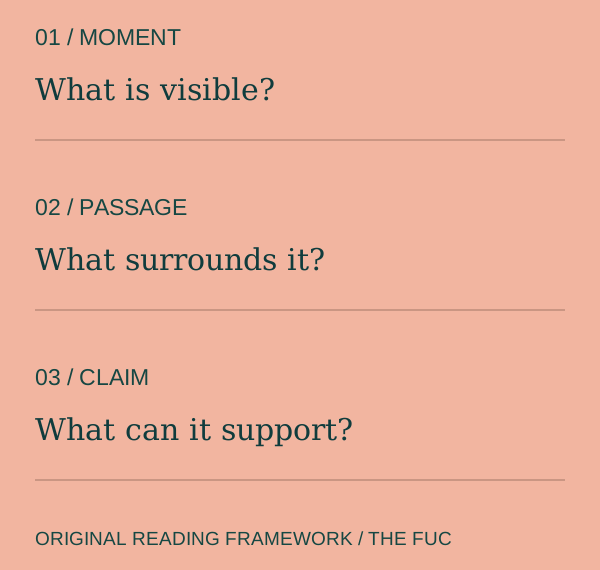
Build a short evidence ladder
The diagram in this essay moves through three stages: moment, passage and claim. Start with what is visible, then seek the surrounding sequence, then return to the proposed conclusion. The order matters. If you begin by defending the conclusion, it becomes easy to collect only the details that support it. Working outward from the observation helps you notice information that complicates your first account. The diagram is a reading framework, not a model that predicts sporting outcomes.
At each stage, add a sentence about uncertainty. The moment may be clear while its context is not. The passage may be available while a player's intention remains inaccessible. The conclusion may be plausible without being uniquely supported. These distinctions prevent an explanation from becoming stronger merely through repetition. A claim repeated in several summaries can still depend on one short clip. Follow the evidence back to its origin before treating multiple retellings as independent confirmation.
Let the format constrain the interpretation
A cricket action belongs to a particular form of the game and a particular match state. The ICC overview of international formats provides a broad introduction to those differences. Use that background to establish the framework, then find the specific competition information if your question depends on a detail. A general guide cannot certify every inference made about an interrupted innings or a specialised local playing condition.
When the framework is uncertain, reduce the claim rather than guessing. You can describe a boundary without asserting that it was the correct risk for the situation. You can note a defensive passage without deciding that the batting side abandoned its plan. A narrower statement may be less dramatic, but it remains available for later readers to build on. An unsupported strategic judgment often has to be discarded entirely when the missing context finally appears.
Do not let a ratio become a biography
Imagine a fictional batter scoring eighteen runs from twelve balls in the selected clip's broader sample. The resulting strike rate is one hundred and fifty. That calculation is reproducible: divide eighteen by twelve and multiply by one hundred. It describes scoring speed within the supplied sample. It does not describe the player's whole career, establish a permanent style or prove what the player would do in another setting. The sample is part of the statement, not a disposable footnote.
Now imagine adding a second fictional innings of twelve runs from eighteen balls. Combined, the sample becomes thirty runs from thirty balls, with a strike rate of one hundred. Neither calculation is dishonest. They answer questions about different samples. The error would be presenting the smaller sample as a stable portrait while concealing the broader record. When you encounter a comparison, ask which observations were included, which were excluded and whether the choice matches the question being asked.
Try a competing account
Before publishing your interpretation, write the strongest alternative explanation you can support from the same material. Perhaps a scoring change reflects a different opportunity rather than a deliberate new approach. Perhaps the apparently decisive moment sits within a longer sequence that had already changed the match. You do not need to invent an equal opposing view when the evidence is strong. You do need to consider reasonable alternatives before deciding that your preferred explanation is the only available one.
The companion note on reading a cricket passage offers a practical observation exercise for this stage. It separates a visible event from an interpretation and an unanswered question. Use it when your first account feels too complete too quickly. The exercise will sometimes reinforce the original claim. At other times it will reveal that the evidence supports a smaller conclusion, or that the question remains open despite an impressive looking replay.
Share the finding and its boundary
A good summary tells the next reader what you established and what you did not. Explain whether you watched a whole passage, inspected a scorecard or relied on a selected clip. Keep any invented arithmetic clearly separated from actual match information. Link to the original source when one is available, and avoid suggesting that a governing body endorses your interpretation merely because you consulted its rules. The boundary around a finding is part of its usefulness.
Return to The FUC journal for the wider reading sequence. A sponsored link to Cricketin's explanatory cricket material offers another reading destination, separate from the primary sources and our original examples. None of these essays promises a winning prediction or removes uncertainty from a contest. Their purpose is simpler: to help a reader move from an arresting image to a statement that another person can understand, check and, when necessary, question.